
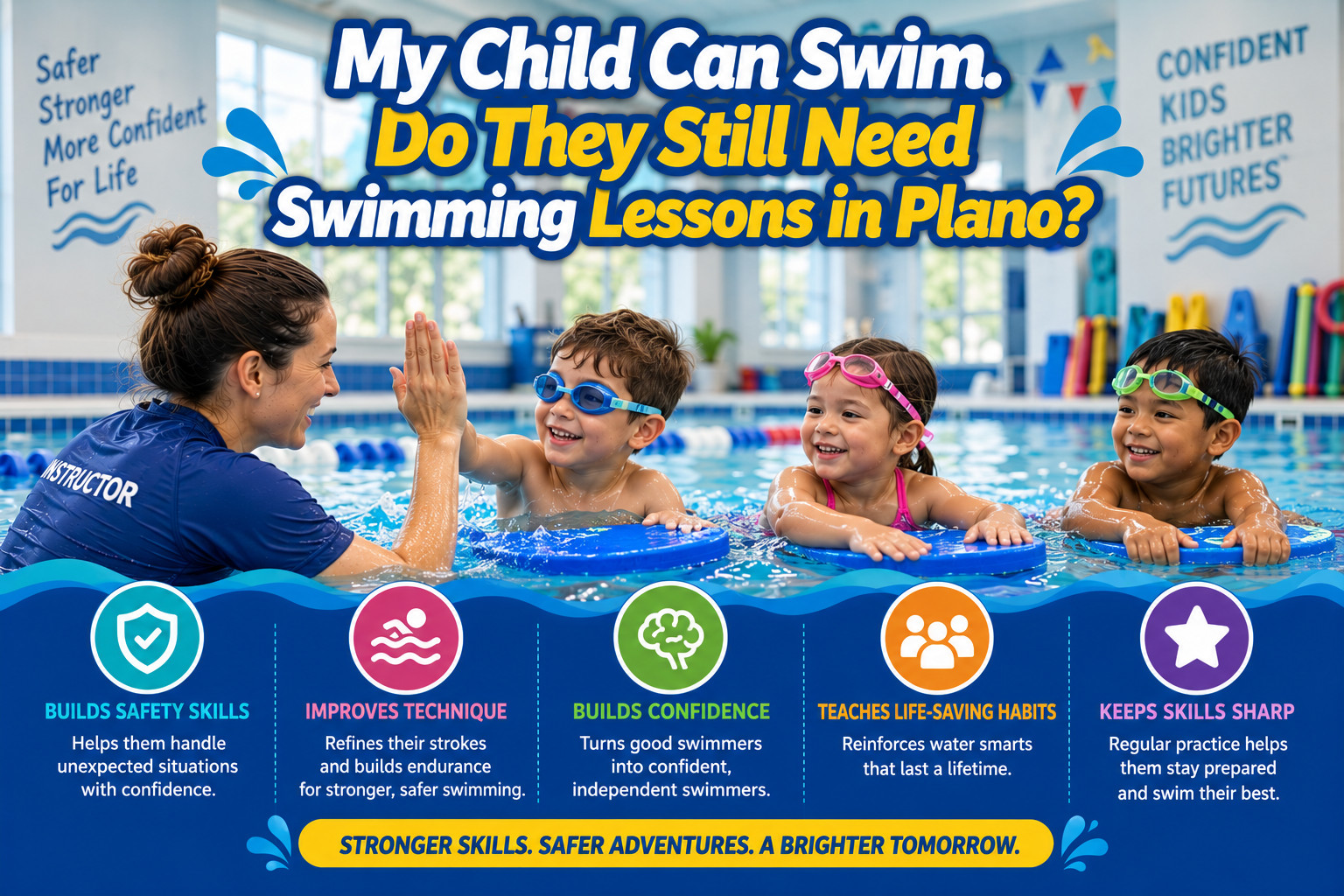
It can be such a proud moment for parents when their child finally jumps off the side of the pool, swims back up to the surface, and then paddles over to the edge where you are watching, with no help required. And when this happens, you’re likely going to ask yourself, “Okay, swimming lessons did their job. Are we done here?”
We won’t deny that when your child can swim independently, it is a cause for celebration. But there’s a difference between knowing how to swim and having a full set of swimming skills. Many families in Plano find that once their child can swim on their own, it’s worth continuing. Swimming lessons in Plano can help kids move past basic independence and work toward better technique, more endurance, and the ability to handle different situations in the water.
What Does “My Child Can Swim” Actually Mean?
Parents use the phrase “can swim” to describe a wide range of abilities. One child might be able to paddle across a small backyard pool. Another might swim several strokes farther without stopping. Both kids “can swim,” but they’re not in the same place.
Now, let’s be realistic. A six-month-old isn’t going to learn how to swim in just a few lessons. Babies aren’t doing laps or perfecting their backstroke. That’s not the point of infant lessons anyway.
Instead of only asking whether your child can get from one side of the pool to the other, ask a few more specific questions.
- Can they control their breathing while they swim?
- Can they float comfortably on their back?
- Can they tread water for a while?
- Can they swim more than a short distance without getting tired?
- Do they know more than one stroke?
- Can they get in and out of the water safely on their own?
If the answer to some of these is no, there’s still plenty of room to grow.
Better Technique Can Make Swimming Easier
Kids often figure out a way to get across the water before they ever learn proper form. They might lift their head too high, kick in a way that doesn’t do much, hold their breath instead of exhaling underwater, or burn a lot of energy just to cover a short distance.
An instructor can spot these habits and help a child fix them one at a time. Better body position, breathing, kicking, and arm movement work together, and small changes add up. This isn’t only for kids headed toward a competitive swim team. Any child who swims for fun benefits from moving through the water with less effort.
Endurance Is Different From Swimming a Short Distance
Swimming across a small pool is not the same as swimming for ten or fifteen minutes straight. Lessons help kids build stamina little by little while keeping their form in place, instead of just powering through and tiring out fast.
When your child gets tired and fatigued, it will change how they swim. Their arms will get heavier, kicks will no longer have that clear definition, and their breathing will become more labored. Kids need practice recognizing when they’re getting tired so they know when to slow down, float, or head back to the wall. That skill matters once they’re at a bigger pool, a water park, or on a beach vacation, where the water isn’t as small or predictable as a backyard pool.
There Is More Than One Way to Swim
Most kids learn to swim independently by starting with one basic stroke. From there, they can start learning and sharpening other strokes, like freestyle, backstroke, breaststroke, and butterfly, depending on what fits their age and current skill level.
Learning more than one stroke builds coordination and gives a young swimmer more than one way to move comfortably through the water. It also keeps lessons interesting once the first big milestone is reached.
Water Skills Still Matter as Children Become Stronger Swimmers
Being a stronger swimmer doesn’t automatically mean a child is prepared for every situation in the water. Lessons reinforce habits like knowing their own limits, staying calm if something unexpected happens, treading water, floating to rest, and getting in and out of the pool safely. Supervision and good water-safety habits still matter no matter how well a child swims.
How Do You Know When Your Child Is Ready to Stop Lessons?
No single milestone answers this for every family. A good place to start is thinking back to the goals you had when your child began lessons and asking whether those goals have changed. Talking with your child’s instructor helps too, since they can walk you through current abilities, spots that could use more work, and what skills come next.
At some point, your family might decide formal lessons aren’t the priority anymore. That’s a fair call, but it works best when it’s based on the full picture of your child’s abilities, not just “they can swim.”
Swimming Independently Can Be the Beginning, Not the Finish Line
Independent swimming is something to be proud of, and it also opens the door to a lot more. Continued instruction can shift from teaching a child how to swim toward helping them become a more capable, well-rounded swimmer.
Families considering continued swimming lessons in Plano can explore Tatsuki Swimming School’s programs to find the right level for their child’s current abilities and next goals in the water.